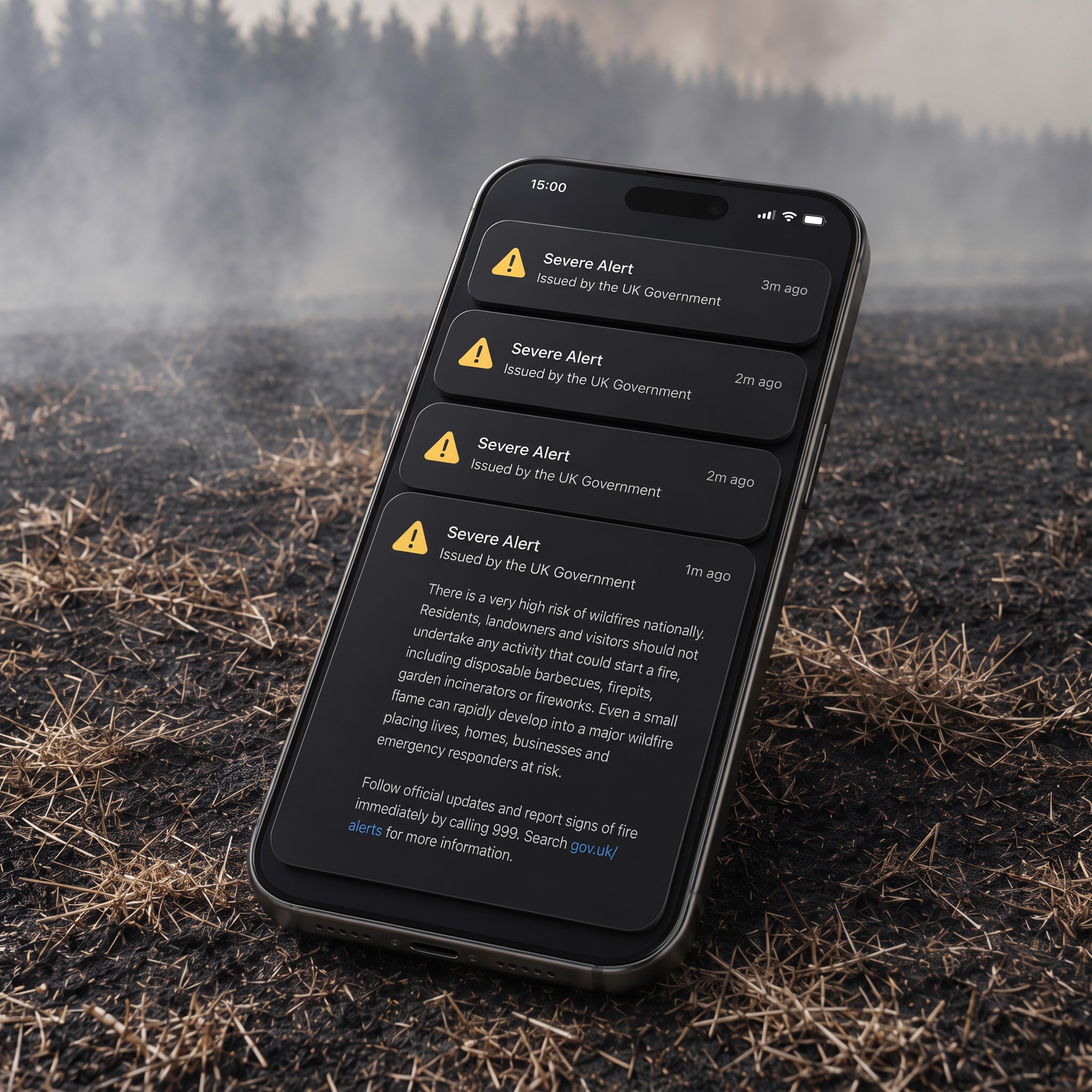

Last week, millions of people across the UK received a government emergency alert warning of wildfire risk. And it prompted us to ask this question.
The government alert certainly got attention. Phones sounded. Screens flashed. People talked about it.
There’s an understandable instinct to make alarming subjects feel alarming. To use urgent language, dramatic imagery and the strongest possible call to action.
But as creatives, we have a responsibility to ask whether that's actually the most effective approach.
Because attention isn't the same as action. And fear isn't always the best route to either.
Creative responsibility matters
For agencies, this is particularly important when working with clients in sectors where the subject matter genuinely carries weight – insurance, healthcare, financial services, utilities and beyond.
The creative job isn't simply to make something stand out.
It's to understand the subject, the audience and the desired response, then find the right way to communicate it.
Sometimes that means creating urgency. Sometimes it means making complex information easier to understand. And sometimes it means deliberately taking the temperature down.
We experienced this with The Brain Tumour Charity.
The subject was undeniably serious, but the creative didn't rely on fear or distress to get people's attention. Instead, we used a distinctive, memorable idea to make people stop, engage with the subject and, importantly, recognise the symptoms that could prompt them to seek help. Of which over 50% of people can now name a symptom of a brain tumour.
The subject stayed serious. The communication didn't need to be sombre.
That's an important distinction.
Turning up the volume isn't always the answer
The government alert is a useful reminder that the channel and the creative treatment can be just as important as the message itself.
An emergency notification on your phone carries a very different emotional weight from a social post, an outdoor campaign or a report.
And when audiences are increasingly surrounded by messages competing for their attention, simply making something louder isn't necessarily going to make it more effective.
As creatives, we have a responsibility to think beyond "Will people notice this?"
We should also be asking:
How will they feel? What will they remember? And what will they do next?
Because when the message matters, how you say it matters more.
At twcreative®, we believe that's where creative judgement really earns its place.
Not just in making important messages impossible to ignore, but in making sure they're impossible to misunderstand.


Let’s keep in touch.
Discover more about high-performance design. Follow us on LinkedIn and Instagram.



